


ABOUT THE DEPARTMENT
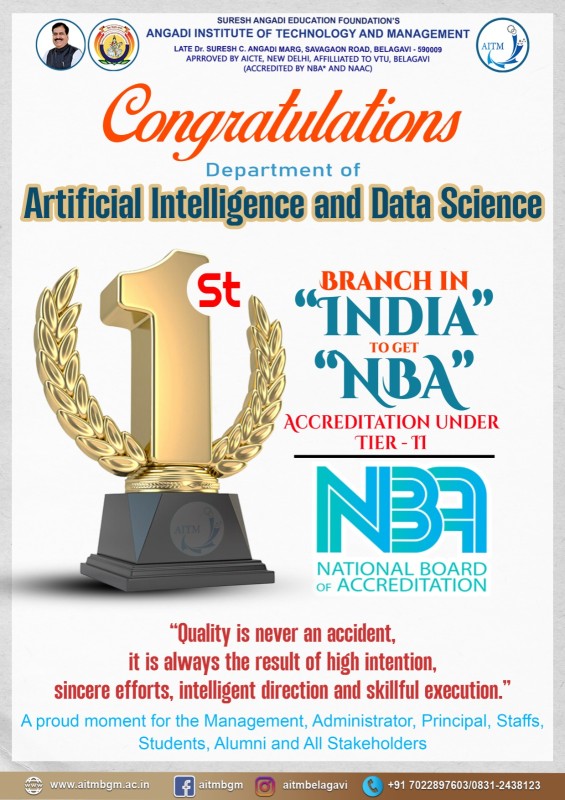
The Department of Artificial Intelligence and Data Science is dedicated to excellence in academics, research, innovation, and industry-oriented skill development. The department is proud to be the first AI & DS program among Tier-II institutions in India to receive NBA Accreditation, reflecting its commitment to quality education and outcome-based learning.
The department fosters a strong research culture through publications in reputed journals and conferences, along with patents and copyrights in emerging areas such as Artificial Intelligence, Machine Learning, Deep Learning, Computer Vision, and Data Science.
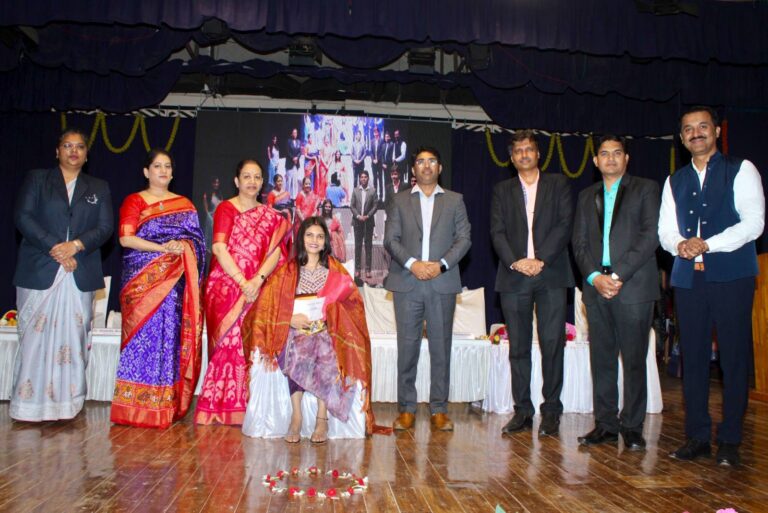
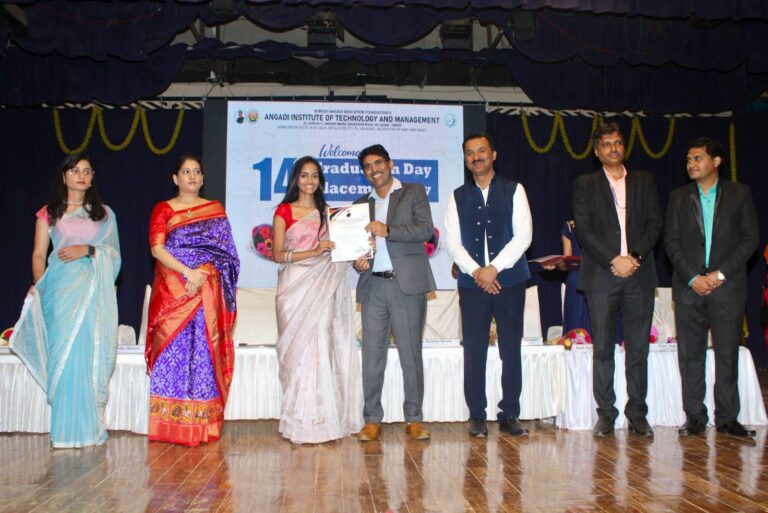
Students are provided with extensive exposure through workshops, certifications, internships, industry interactions, hackathons, and research activities. Their achievements are reflected in outstanding academic performance, including VTU Gold Medalist Miss Meghana Anil Pawar (1st Rank), Miss Mayuri Tayasaheb Patil (6th Rank), and Miss Deepa Mahantesh Benni (10th VTU Rank).
The department emphasizes industry readiness by training students in AI, Machine Learning, Data Science, Generative AI, Cloud Computing, Big Data Analytics, and Business Intelligence. As a result, students secure placements in reputed organizations with packages ranging from ₹4 LPA to ₹9 LPA in core IT companies, serving in roles such as AI Engineer, Data Scientist, Machine Learning Engineer, Data Analyst, and Software Developer.
With a strong focus on academic excellence, research, innovation, university ranks, and successful placements, the Department of Artificial Intelligence and Data Science continues to develop future-ready professionals and technology leaders.
VISION OF DEPARTMENT
To deliver a quality and responsive education in the field of artificial intelligence and data science emphasizing professional skills to face global challenges in the evolving IT paradigm.
MISSION OF DEPARTMENT
- Leverage multiple pedagogical approaches to impart knowledge on the current and emerging AI
technologies. - Develop an inclusive and holistic ambiance that bolsters problem solving, cognitive abilities and critical thinking.
- Enable students to develop trust worthiness, team spirit, understanding law-of-the-land, social
behaviour to be a global stake holder
HOD'S MESSAGE
Welcome to the Department of Artificial Intelligence and Data Science.
Artificial Intelligence and Data Science have emerged as transformative technologies of the 21st century, revolutionizing industries, businesses, and society at an unprecedented pace. Recognizing the growing importance of these domains, the Department of Artificial Intelligence and Data Science was established in the year 2020 with an initial intake of 60 students. Owing to the increasing demand for AI and Data Science professionals and the department’s remarkable academic progress, the intake has been enhanced to 120 students from the academic year 2026–27.
The department has achieved a significant milestone by becoming the first Artificial Intelligence and Data Science program in India under Tier-II Institutions to receive NBA Accreditation. This prestigious recognition reflects our commitment to academic excellence, outcome-based education, continuous improvement, and quality technical education.
Our department is dedicated to delivering innovative, industry-relevant, and high-quality education in the fields of Artificial Intelligence, Machine Learning, Data Analytics, Big Data, and emerging technologies. We adopt modern teaching-learning methodologies that encourage critical thinking, creativity, problem-solving, and lifelong learning among students. Our experienced and highly qualified faculty members are actively involved in research and innovation, contributing through research publications in reputed journals and conferences, patents, copyrights, and funded projects.
We strive to provide students with a strong foundation in Artificial Intelligence and Data Science while equipping them with interdisciplinary skills in statistics, mathematical modeling, logical reasoning, data visualization, knowledge discovery, and advanced analytics. Beyond academics, the department fosters a vibrant research-oriented environment through value-added courses, certification programs, workshops, internships, industrial interactions, and skill development initiatives.
Students are encouraged to actively participate in national-level technical competitions, hackathons, coding contests, innovation challenges, and research activities. Their achievements in these prestigious events reflect the department’s commitment to nurturing innovation, leadership, and technical excellence. We take pride in the successful placement of our students in leading organizations, where they are contributing in core domains such as Artificial Intelligence, Machine Learning, Data Science, Data Analytics, and Software Development.
At the Department of Artificial Intelligence and Data Science, we are committed to creating competent professionals, innovative researchers, and responsible citizens who can effectively address the challenges of the rapidly evolving digital world. I am confident that our students will continue to excel and make meaningful contributions to society through technological innovation and data-driven solutions.

Prof. Sagar Birje
HOD, AI & DS
M.Tech,(Ph.d)
Program Educational Objectives (PEOs)
PEO1 : Build a strong foundation in mathematics, core programming, artificial intelligence, machine learning, and data science to enable graduates to analyze, design, and implement intelligent systems for solving complex real-world problems.
PEO2 : Foster creativity, cognitive and research skills to analyze the requirements and technical specifications of software to articulate novel engineering solutions for an efficient product design.
PEO3 : Prepare graduates for dynamic career opportunities in AI and Data Science by equipping them with interdisciplinary knowledge, adaptability, and practical exposure to tools and techniques required for industry and research.
PEO4 : Instill a strong sense of ethics, professional responsibility, and human values, empowering graduates to contribute positively to society and lead with integrity in their professional domains.
PEO5 : Encourage graduates to pursue higher education, certification program, entrepreneurial ventures, etc. by nurturing a mindset of continuous learning and awareness of global trends and challenges.
Program Outcomes (POs)
PO1: Engineering Knowledge: Apply knowledge of mathematics, natural science, computing, engineering fundamentals and an engineering specialization as specified in WK1 to WK4 respectively to develop to the solution of complex engineering problems.
PO2: Problem Analysis: Identify, formulate, review research literature and analyze complex engineering problems reaching substantiated conclusions with consideration for sustainable development. (WK1 to WK4).
PO3: Design/Development of Solutions: Design creative solutions for complex engineering problems and design/develop systems/components/processes to meet identified needs with consideration for the public health and safety, whole-life cost, net zero carbon, culture, society and environment as required. (WK5).
PO4: Conduct Investigations of Complex Problems: Conduct investigations of complex engineering problems using research-based knowledge including design of experiments, modelling, analysis & interpretation of data to provide valid conclusions. (WK8).
PO5: Engineering Tool Usage: Create, select and apply appropriate techniques, resources and modern engineering & IT tools, including prediction and modelling recognizing their limitations to solve complex engineering problems. (WK2 and WK6).
PO6: The Engineer and the World: Analyze and evaluate societal and environmental aspects while solving complex engineering problems for its impact on sustainability with reference to economy, health, safety, legal framework, culture and environment. (WK1, WK5, and WK7).
PO7: Ethics: Apply ethical principles and commit to professional ethics, human values, diversity and inclusion; adhere to national & international laws. (WK9).
PO8: Individual and Collaborative Team work: Function effectively as an individual, and as a member or leader in diverse/multi-disciplinary teams.
PO9: Communication: Communicate effectively and inclusively within the engineering community and society at large, such as being able to comprehend and write effective reports and design documentation, make effective presentations considering cultural, language, and learning differences.
PO10: Project Management and Finance: Apply knowledge and understanding of engineering management principles and economic decision-making and apply these to one’s own work, as a member and leader in a team, and to manage projects and in multidisciplinary environments.
PO11: Life-Long Learning: Recognize the need for, and have the preparation and ability for i) independent and life-long learning ii) adaptability to new and emerging technologies and iii) critical thinking in the broadest context of technological change. (WK8)
Program Specific Outcomes (PSOs)
PSO 1: To apply core knowledge of Artificial Intelligence, Machine Learning, Deep Learning, Data Science, Big Data Analytics and Statistical Learning to develop effective solutions for real-world problems.
PSO 2: To demonstrate proficiency in specialized and emerging technologies such as Natural Language Processing, Cloud Computing, Robotic Process Automation, Storage Area Networks and the Internet of Things to meet the stringent and diverse professional challenges.
PSO 3: To imbibe managerial skills, social responsibility, ethical and moral values through courses in Management and Entrepreneurship, Software Engineering Principles, Universal Human Values and Ability Enhancement Programs to meet the industry and societal expectations.
.